
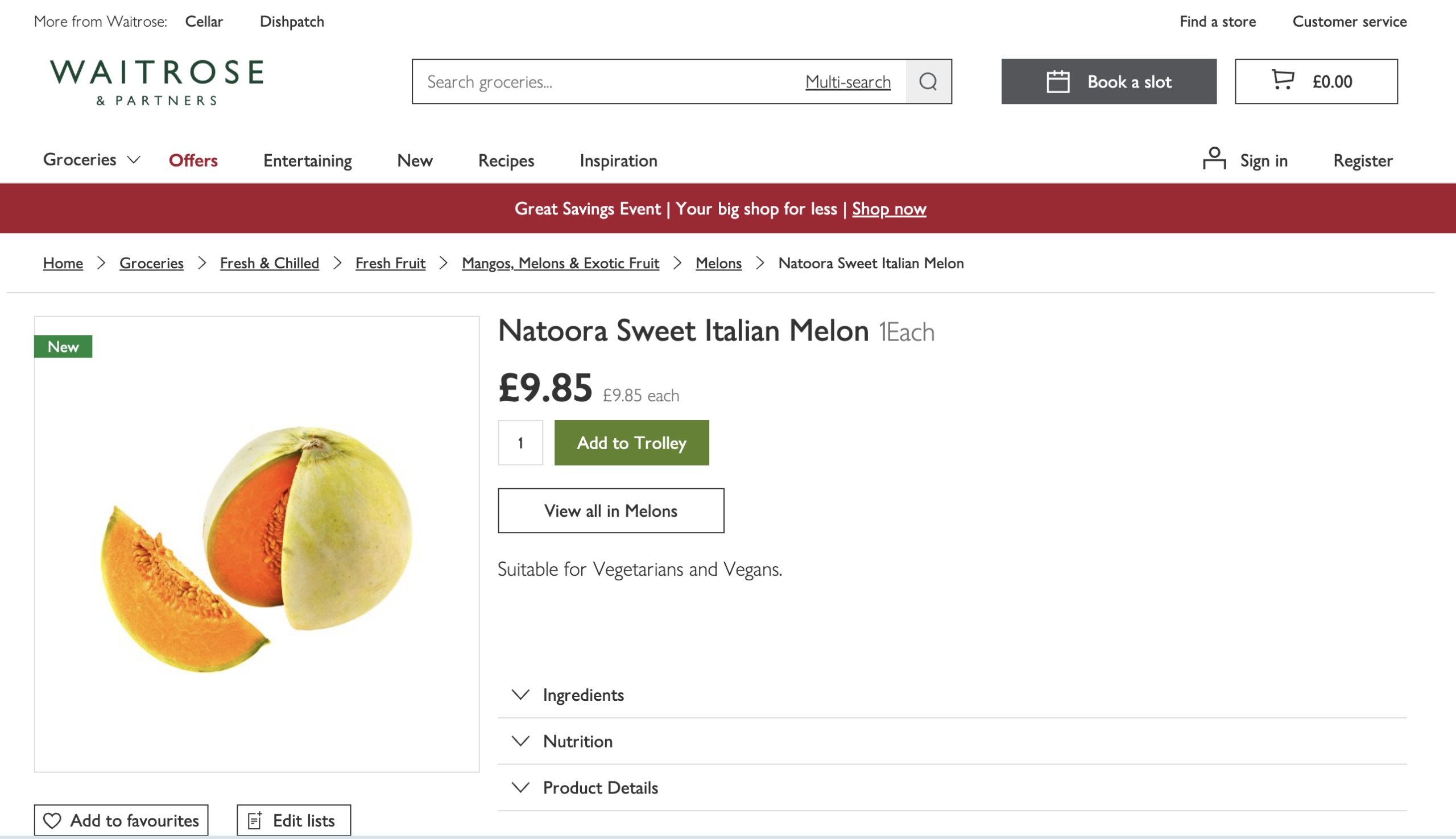
Today I stood in front of a melon for an embarrassingly long time. It was a tiny Italian sweet melon, the kind I used to buy at the market in Italy. It cost £7.88 (ON OFFER), which for something that small felt completely ridiculous. But I picked it up and smelled it, and for a second I wasn’t standing in a supermarket in London anymore. I was back in Italy. I could remember buying those melons at the market, taking them home, cutting them open and eating them. I remembered exactly how sweet they were, how they smelled, how much I loved them.
Food does this to me sometimes. A smell or a taste can suddenly take me somewhere else, so vividly that it feels less like remembering and more like briefly being there again. I love that feeling. So I stood there with this stupid little melon in my hands thinking, do I buy it? Do I not buy it? Do I buy it? Do I not buy it?
Eventually I put it back. Almost eight pounds for one tiny melon was just too much. I walked away and continued through the supermarket to get the bread I had actually gone there for.
But as I walked around, I started looking at everything else. I was in Waitrose, so obviously there were plenty of things that were more expensive than the versions I normally buy. Better ingredients, different products, things that looked genuinely good. And suddenly I had this thought: why do I almost never allow myself to buy these things? My instinct is always to look for the bargain. Find the reduction. Compare the prices. Go somewhere cheaper. If two things can perform roughly the same function, buy the cheaper one. And to be fair, this has worked. Over the years I have saved a huge amount of money by living like this. I’ve become very good at it.
But walking around the supermarket today, I started wondering why saving money always seems to win, even when I know that sometimes the more expensive thing would genuinely be better. Not because it has a nicer label or because expensive automatically means good, but simply because sometimes there really is a difference.
Sometimes something tastes better. Sometimes it is made better. Sometimes it gives you more pleasure. And why don’t I allow myself that pleasure? I don’t want to suddenly start buying the most expensive version of everything. That isn’t the point. There are plenty of things I couldn’t care less about. Oats are oats. I’m going to throw them into a bowl with fruit and make porridge. I don’t need luxury oats. Give me the cheap ones. But there are other things where I can taste the difference immediately. And I started wondering why, even then, my first thought is still: no, that’s too expensive. You don’t need that. Take the cheaper one.
Why? I think what bothered me about that thought was the feeling that, once again, I wasn’t part of the calculation. There was the price. There was the saving. There was whether I technically needed something. There was whether a cheaper version could do the same job. But nowhere in that calculation was: Would this make me happy? Would I enjoy this more? Can I simply choose something better because I would really like it? It’s strange to realise how easily you can deny yourself small pleasures without ever consciously deciding to do it. You just develop rules. Be sensible. Don’t waste money. Find the cheapest option. Save. Save. Save. And after a while you stop asking what you’re saving at the expense of.
Maybe lately I am questioning that because I have started thinking a lot about what it actually means to take care of myself. Not the Instagram version of self-care. Not candles and bubble baths and inspirational quotes. I mean something much more ordinary: letting myself matter when I make decisions. My money matters. Being responsible with it matters. My future matters. But surely my experience of my own life matters too. Maybe I am allowed, sometimes, to choose the thing that tastes incredible instead of the thing that simply does the job. Maybe I am allowed to spend a little more money on something for no better reason than that I will enjoy it. Maybe pleasure doesn’t always need to justify itself by being useful.
It isn’t about becoming careless with money. I don’t want to stop looking for bargains. I actually enjoy finding them. I don’t want to start believing that expensive means better. Most of the time it doesn’t. I just don’t want myself to be the thing I automatically economise on anymore. So perhaps that’s the new rule. Save where the difference means nothing to me. Spend where the difference brings me genuine pleasure. Keep being careful with money, but stop behaving as though every pound spent purely on myself is a pound wasted.
I still didn’t buy the £7.88 melon. But I walked out of the supermarket thinking that maybe, one day, I will. And next time, perhaps I won’t need quite so long to decide whether I’m worth it.
Leave a Reply