
A few days ago, I was out walking when I suddenly thought: You know what? I want to go to the library. I wasn’t looking for a particular book. I just felt that I needed to find something that could help me through this particular moment of my life. Maybe a different perspective. Maybe an idea I hadn’t considered. Maybe one sentence capable of producing that little click in my brain that sometimes changes the way I see something. I walked into the library without knowing what I was looking for and walked out carrying five books.
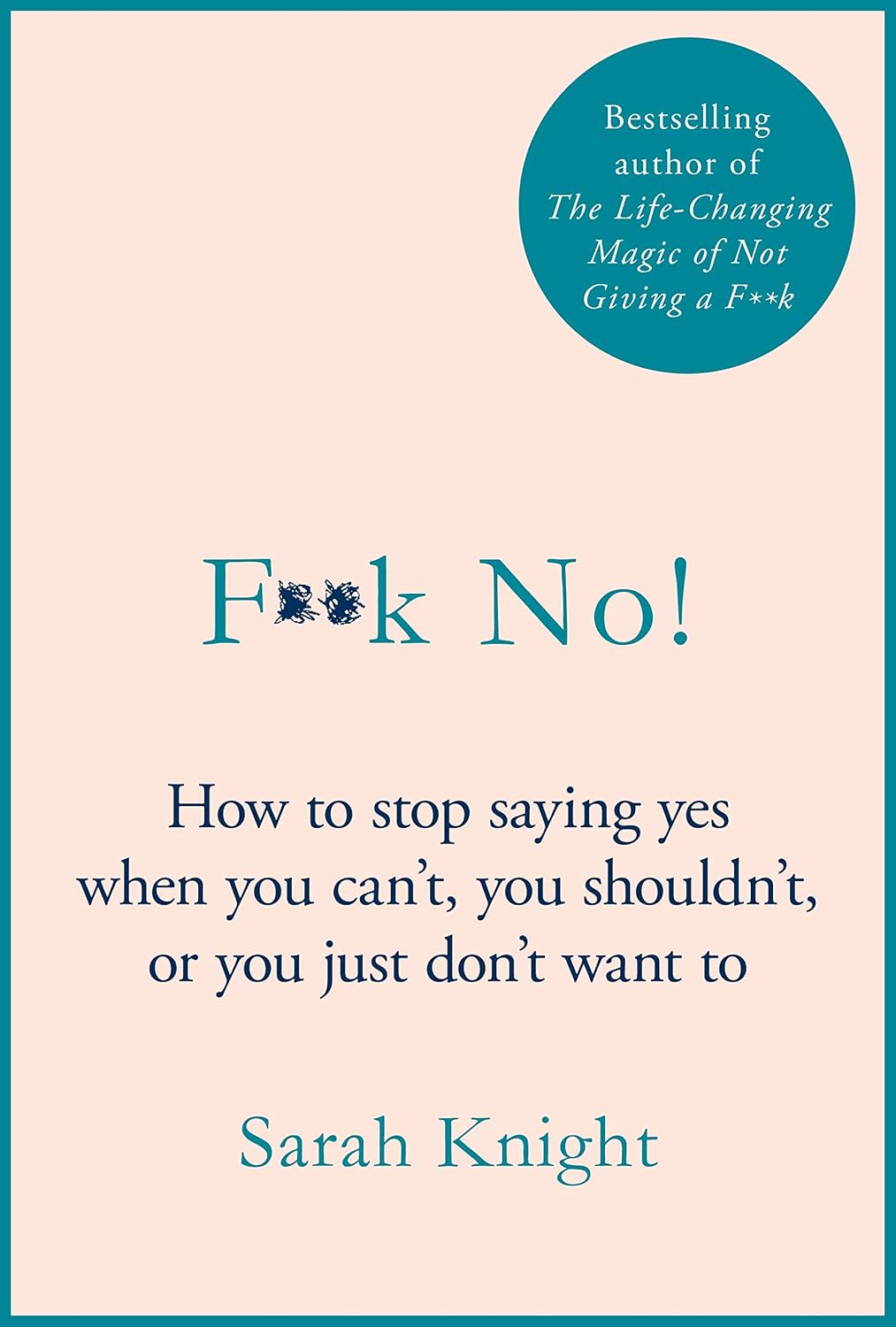
One of them was F*ck No! by Sarah Knight.
I picked it up for a very simple reason: there is a part of me that still doesn’t know how to say fuck no.
I started reading it and very quickly recognised myself in one of the types Knight describes: the People-Pleaser. That wasn’t exactly a shocking revelation. I’ve known for a long time that boundaries are difficult for me. But reading about it made me realise that perhaps my biggest difficulty has never been the actual word no. Sometimes I can say no. The real problem begins afterwards.
Was I selfish? Could I have made more of an effort? Maybe I should have said yes. Did I disappoint them? Was my reason good enough? Could I have managed somehow?
I can put a boundary in place and then spend hours internally putting that boundary on trial.
And when I think about it, that’s fascinating. Because if I believe I need a sufficiently good reason to say no, then is my no really mine? If I have to prove to myself that I was exhausted enough, busy enough, uncomfortable enough or unhappy enough to justify refusing something, then I am still behaving as though somebody else has the final authority over my time and energy.
Over the last few weeks, however, I’ve been experimenting with something that sounds ridiculously simple but doesn’t feel simple at all: I am trying to do what I actually want to do instead of what I think I should do.
Not What would be the nice thing to do? What will make everybody else comfortable? What is expected of me? What will make me look selfish if I refuse? But: What do I actually want? What do I need right now?
And something interesting is happening.
I don’t seem to be becoming a terrible person.
The world hasn’t collapsed. I haven’t suddenly stopped caring about anyone. I haven’t become incapable of generosity or empathy. What I have noticed instead is that I seem to be recovering from this difficult period faster than I have recovered from difficult periods in the past. I am giving myself space. I am protecting my energy. I am spending more time doing things that make me feel like myself again. And perhaps, for once, I am not using the little energy I have left to constantly negotiate between what I need and what everybody else might want from me.
It has also made me wonder about something slightly uncomfortable: how much of what I have called generosity in my life was actually generosity, and how much of it was my inability to tolerate the guilt of saying no?
Because there is a difference between saying yes because I genuinely want to give something to another person and saying yes because saying no makes me feel like a bad person.
I’m still reading the book, so perhaps there will be another hundred things in it that make me question myself. But right now this is the idea that has stayed with me: maybe learning to say no isn’t simply about becoming better at setting boundaries with other people.
Maybe it’s also about learning not to punish yourself after you set them.
Maybe sometimes I don’t need an emergency, an excuse or an airtight argument.
Maybe “I don’t want to” is information worth listening to.
And perhaps learning to say fuck no to other people begins with learning to say fuck no to the voice inside my own head that insists I should have said yes.
Leave a Reply