
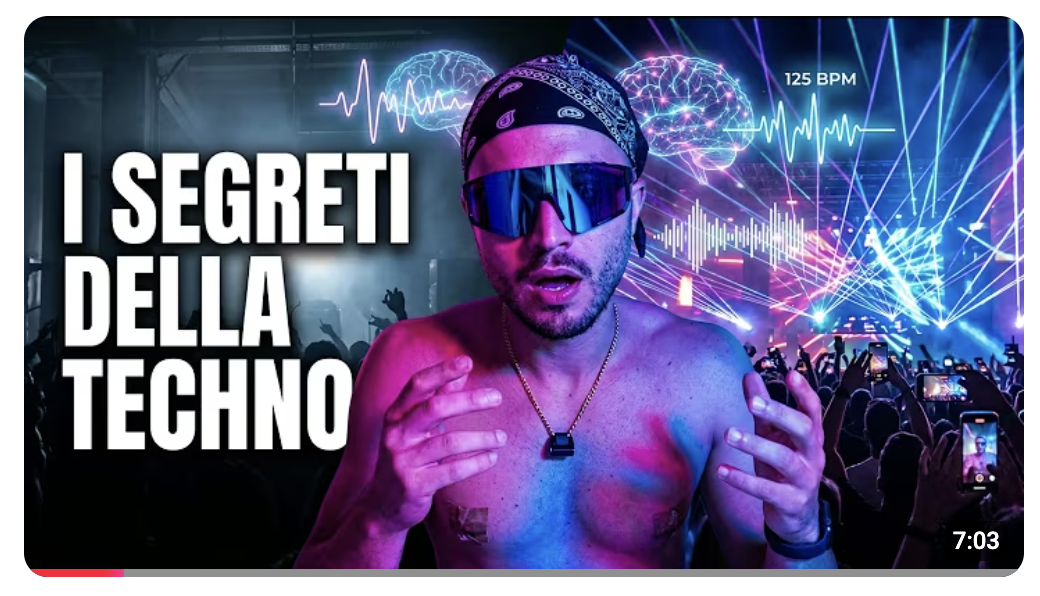
Today I watched a YouTube video that completely changed the way I think about techno. It wasn’t about the best DJs or the history of electronic music. Instead, it explored what actually happens inside our brains when we dance for hours. It talked about brain waves, the prefrontal cortex, collective experiences, and why repetitive rhythms can temporarily change our state of consciousness. If you’re interested in neuroscience, I genuinely recommend watching it. I’ll leave the link at the end of this post because this article wouldn’t exist without that video.
But when it ended, I realised the science wasn’t the part that stayed with me. The question was.
Why do we dance?
For years I thought the answer was simple. We dance to have fun, to listen to music, to meet people, to celebrate. But now I think it’s something much deeper than that.
Most of our lives are spent inside our own minds. We’re constantly thinking about work, relationships, money, health, the future, the past, the mistakes we’ve made, the things we still have to do tomorrow. Our brains rarely stop talking. Then something changes. The lights go down, the music starts, the kick drum becomes constant, and your body finds the rhythm before your mind does. Almost without noticing, that endless internal conversation begins to disappear.
The video explained that there are neurological reasons for this. Certain parts of the brain become less active, allowing us to enter what psychologists call a flow state. I don’t know enough neuroscience to explain it better than the people who study it, but I know what it feels like.
I’ve felt it.
There are moments on a dancefloor when you stop experiencing yourself as a collection of responsibilities, worries and labels. You’re no longer the person with a job, a diagnosis, a history or a list of problems to solve. You’re simply another human being moving together with hundreds of other human beings.
I think that’s one of the reasons I’ve always loved underground electronic music. At its best, it isn’t about performing. It isn’t about looking cool. It isn’t even about the DJ. It’s about creating a space where, for a little while, people can stop carrying themselves so tightly. A space where nobody cares what you do for a living, how many followers you have or what your story is. You’re simply there, sharing the same rhythm with complete strangers.
The video also talked about how this culture has changed over the years. How something that was born as a refuge for marginalised communities has, in many places, become another product to sell. Bigger stages, bigger brands, bigger influencers. Maybe that’s true. But I don’t think authenticity disappears that easily. I’ve been in places where the original spirit is still alive, where people aren’t trying to impress anyone. They’re simply trying to feel alive.
Maybe that’s why dancefloors have always felt different to me. In everyday life we’re constantly asked who we are. What do you do? Where are you from? What’s your job? What’s your identity? On a dancefloor, for a few hours, those questions stop mattering.
Sometimes the greatest freedom isn’t becoming someone new.
It’s forgetting, just for a little while, that you have to be anyone at all.
Credit
This reflection was inspired by a YouTube video about the neuroscience and history of techno. If you’d like to explore the science behind these ideas, I highly recommend watching the original video. It sparked this article, even though the thoughts I’ve shared here are entirely my own.
Leave a Reply